PVC Roofing in Maryland
Chemical-resistant, fire-rated PVC membrane systems for restaurants, factories, and commercial buildings that demand the highest performance. Heat-welded seams and a 25–30 year lifespan.
What Is PVC Roofing & When Is It the Right Choice?
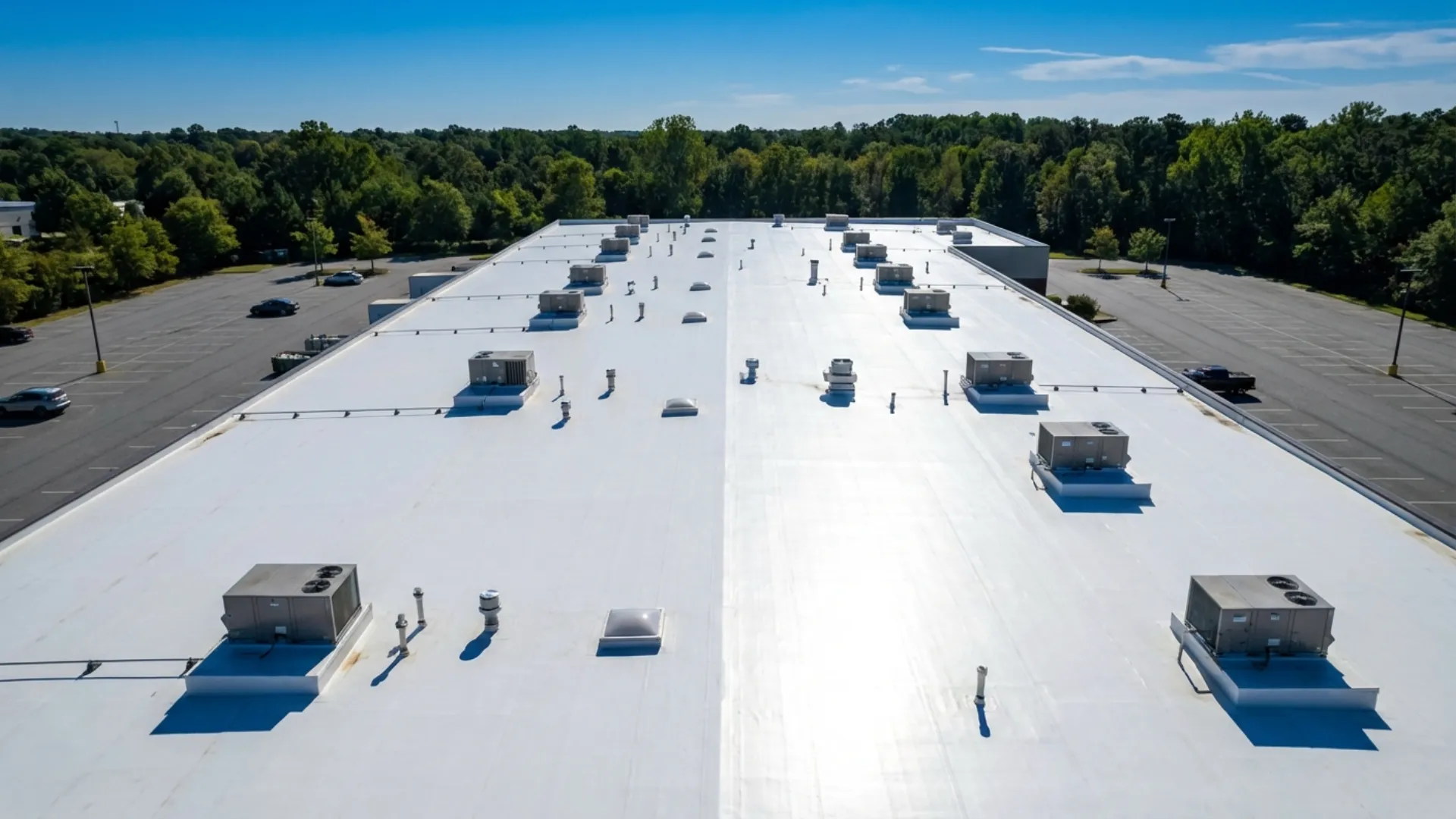
PVC — polyvinyl chloride — is the premium single-ply roofing membrane for commercial buildings that face chemical exposure, grease-laden exhaust, or demanding fire code requirements. While TPO and EPDM serve the general commercial market well, PVC occupies a distinct niche: buildings where the roof must resist substances that would destroy other membranes over time.
The chemistry of PVC makes it uniquely suited for this role. Its chlorine content provides inherent fire resistance, achieving UL Class A fire ratings without additional treatments. The plasticizers and stabilizers in PVC formulations create a membrane that is impervious to animal fats, vegetable oils, petroleum-based chemicals, bacterial growth, and most industrial solvents. This is why PVC is the go-to membrane for restaurants, food processing facilities, auto repair shops, chemical plants, and medical buildings across Maryland.
Like TPO, PVC uses hot-air welded seams that create bonds stronger than the membrane itself. In fact, PVC was the original heat-welded single-ply membrane — the technology was developed for PVC in Europe in the 1960s and has over 60 years of proven performance data. PVC seam welds consistently demonstrate the highest peel and shear strength values among all single-ply membranes, which is why many building owners and architects specify PVC for critical applications where failure is not an option.
At Crown Remodeling, we install PVC systems from leading manufacturers including Sarnafil, IB Roof Systems, Duro-Last, and GAF. Our certified crews understand the specific installation requirements that differentiate PVC from other thermoplastic membranes, including the need for separator sheets when recovering over asphalt-based roofs and the temperature parameters for optimal seam welding. Every PVC installation we complete is backed by manufacturer NDL warranties and our own workmanship guarantee.
Chemical Resistance
Resists animal fats, oils, solvents, and industrial chemicals that destroy TPO and EPDM membranes.
UL Class A Fire Rating
Inherently fire-resistant due to chlorine content. Self-extinguishing — meets the strictest building fire codes.
25–30 Year Lifespan
The longest-lasting single-ply membrane. Some PVC roofs installed in the 1970s are still in service today.
Strongest Seam Welds
60+ years of heat-welding data. PVC seam strength consistently exceeds all other single-ply membranes.
PVC Roofing Pricing by Building Size
PVC is a premium membrane that costs more upfront but delivers superior longevity, chemical resistance, and fire protection. Pricing includes all materials, labor, and cleanup.
Under 5,000 Sq Ft
Restaurants, small medical offices, auto repair shops, and specialty retail.
- 60-mil PVC membrane standard
- Full tear-off and insulation
- All flashing and penetration details
- 20–25 year manufacturer warranty
- Project total: $35,000–$50,000
5,000 – 15,000 Sq Ft
Restaurant groups, medical centers, manufacturing facilities, and multi-unit commercial.
- 60-mil or 80-mil PVC membrane
- Tapered insulation for drainage
- Chemical-resistant flashing details
- 25–30 year NDL warranty available
- Project total: $45,000–$135,000
15,000+ Sq Ft
Food processing plants, chemical facilities, large industrial, and campus buildings.
- 80-mil PVC recommended
- Phased installation available
- Complete drainage system design
- 25–30 year NDL warranty available
- Project total: $90,000–$240,000+
Why Specify PVC for Your Building
PVC is the premium choice when your building demands more than basic waterproofing. Here is what sets PVC apart from every other flat roofing membrane.
Chemical Resistance
Impervious to animal fats, vegetable oils, petroleum chemicals, solvents, and bacterial growth. The only single-ply membrane suitable for restaurant and industrial exhaust exposure.
Fire Resistance
UL Class A fire rating — the highest available. PVC self-extinguishes rather than propagating flame. Meets the strictest fire codes for dense commercial areas and property-line buildings.
Longest Lifespan
25–30 year expected lifespan — the longest of any single-ply membrane. Some PVC roofs from the 1970s are still performing, backed by decades of real-world data.
Superior Seam Strength
60+ years of heat-welding performance data. PVC seam welds achieve the highest peel and shear strength of any single-ply membrane tested.
Energy Efficient
White PVC is ENERGY STAR rated with solar reflectance comparable to TPO. Reduces cooling costs by 10–30% while providing chemical and fire resistance that TPO cannot match.
Root Resistance
PVC membranes are naturally root-resistant, making them the ideal waterproofing layer for green roof and rooftop garden installations on commercial buildings.
When to Choose PVC Roofing
PVC is the clear winner in specific scenarios where its unique properties justify the premium price. If your building fits any of these profiles, PVC will outperform every alternative.
- Restaurants and food service buildings with rooftop kitchen exhaust that deposits grease and animal fats onto the roof surface
- Manufacturing and chemical facilities where industrial solvents, petroleum products, or chemical fumes contact the roof
- Auto repair shops and service centers with oil and fuel vapors that degrade TPO and EPDM membranes over time
- Buildings requiring Class A fire ratings near property lines, in dense commercial areas, or per local fire code requirements
- Medical facilities and laboratories with chemical ventilation exhaust or sterilization fumes
- Green roof and rooftop garden installations that need root-resistant waterproofing beneath the growing medium
Consider alternatives if: Your building has no chemical exposure and you want the best value — TPO roofing offers comparable energy efficiency at a lower cost. For the most budget-friendly option, see EPDM roofing.
PVC vs. Other Membranes
PVC Roofing Installation Process
PVC installation requires certified expertise. Our process ensures every detail meets manufacturer specifications for maximum warranty protection.
Chemical Exposure Assessment
Beyond standard roof inspection, we evaluate your building's exhaust systems, chemical exposure sources, and fire code requirements to confirm PVC is the right specification.
System Design & Proposal
Detailed proposal specifying PVC thickness, attachment method, insulation plan, drainage design, and warranty options. Special attention to exhaust penetration details.
Permits & Scheduling
All permits secured from local jurisdiction. Installation phased around your restaurant hours or manufacturing schedule to minimize operational disruption.
Tear-Off & Separation
Existing membrane removed. If recovering over asphalt-based roofing, a separator sheet is installed to prevent chemical incompatibility between asphalt and PVC.
Insulation & Membrane Install
Polyiso insulation boards installed to code R-values. PVC membrane sheets positioned, mechanically fastened or fully adhered, and seams hot-air welded for monolithic seal.
Penetration Detailing
Critical step for PVC. All exhaust fan curbs, grease hoods, chemical vents, and HVAC units are flashed with PVC-compatible accessories and heat-welded for chemical-proof seal.
Quality Inspection & Testing
Every seam, flashing, and transition tested. Electronic leak detection or flood testing confirms complete waterproofing. Particular focus on chemical exposure zones.
Warranty & Documentation
NDL manufacturer warranty registered. Complete documentation package provided including as-built details, warranty certificate, and maintenance schedule for your records.
PVC Roofing Across Maryland & Beyond
Licensed in 4 states. We serve businesses and property managers across these counties and more.
PVC Roofing FAQ
PVC roofing in Maryland typically costs $6 to $10 per square foot installed, depending on membrane thickness, building size, and project complexity. A 10,000 sq ft commercial roof runs approximately $60,000 to $100,000 fully installed. While PVC costs more upfront than TPO or EPDM, its superior chemical resistance, fire rating, and 25–30 year lifespan deliver a lower total cost of ownership for buildings that need these properties.
PVC costs more ($6–$10/sq ft vs $5–$8/sq ft for TPO) because of its superior chemical resistance formulation, inherent fire resistance from chlorine content, and longer expected lifespan (25–30 years vs 20–30 years for TPO). PVC membranes contain specialized plasticizers and UV stabilizers that make them impervious to grease, oils, solvents, and chemicals. For buildings that need this protection, the premium pays for itself in avoided membrane damage and longer replacement cycles.
PVC roofs typically last 25 to 30 years, making them the longest-lasting single-ply membrane available today. Some PVC roofs installed in the 1970s are still in service — a testament to the material's durability and UV stability. The combination of chemical resistance, fire resistance, and heat-welded seam integrity contributes to PVC's exceptional longevity. Regular maintenance extends lifespan even further.
PVC is the recommended roofing membrane for restaurants and all food service buildings. Kitchen exhaust systems deposit grease and animal fats onto the roof surface around exhaust fans and hood vents. These substances break down TPO and EPDM membranes over time, causing premature failure. PVC is chemically inert to animal fats and vegetable oils, maintaining full integrity even with continuous grease exposure. If your building has rooftop kitchen exhaust, PVC is the only single-ply membrane that will hold up long-term.
PVC membranes resist a wide range of substances including animal fats (from restaurant exhaust), vegetable oils, petroleum-based chemicals, jet fuel, diesel, most acids and alkalis, bacterial growth, and many industrial solvents. This makes PVC the standard specification for restaurants, auto repair shops, chemical processing plants, medical facilities, fuel storage areas, and any building where rooftop exhaust or spillage contains substances that would degrade other membrane types.
PVC roofing membranes achieve UL Class A fire ratings, the highest classification available for roofing materials. This is not an added treatment — PVC is inherently fire-resistant because of the chlorine in its chemical composition. When exposed to flame, PVC chars and self-extinguishes rather than melting or propagating the fire. This makes PVC the preferred choice for buildings near property lines, in dense commercial areas, and anywhere strict fire code compliance is required.
Yes, and PVC was actually the original heat-welded single-ply membrane. The hot-air welding technology used on both PVC and TPO was first developed for PVC in Europe in the 1960s. PVC has over 60 years of heat-welding performance data — more than TPO, which adopted the technology later. In testing, PVC seam welds consistently demonstrate the highest peel and shear strength values among all single-ply membranes, making them exceptionally reliable.
Yes, white PVC membranes are highly reflective and ENERGY STAR rated, with solar reflectance comparable to white TPO. PVC can reduce cooling costs by 10–30% depending on building size, insulation levels, and HVAC efficiency. Maryland businesses may qualify for utility rebates from BGE and other providers. The unique advantage of PVC is that it delivers this energy efficiency alongside chemical resistance and fire protection that TPO cannot match.
In many cases, yes, but with an important caveat: PVC is not chemically compatible with asphalt-based roofing products. If recovering over a built-up (BUR) or modified bitumen roof, a separator sheet must be installed between the old roof and the new PVC membrane to prevent chemical interaction that would degrade the PVC. This adds a small cost but is essential for PVC performance. When recovering over existing EPDM or TPO, this separator is not needed. The existing insulation must be dry in all cases.
PVC roofing systems come with manufacturer material warranties ranging from 20 to 30 years — among the longest in the commercial roofing industry. Combined with our workmanship warranty, your investment receives comprehensive protection. We are certified to install systems with manufacturer NDL (No Dollar Limit) warranties that cover both labor and materials with no cap on covered repairs. These warranties reflect the confidence manufacturers have in PVC's long-term performance.
Need a Chemical-Resistant Roof?
Get a free on-site evaluation for your restaurant, factory, or commercial building. We will determine if PVC is the right specification and provide a detailed proposal.