TPO Roofing in Maryland
Energy-efficient thermoplastic polyolefin membrane systems for commercial flat roofs. Heat-welded seams, ENERGY STAR rated, and built to perform for 20–30 years in Maryland's climate.
What Is TPO Roofing & Why Does It Dominate Commercial Construction?
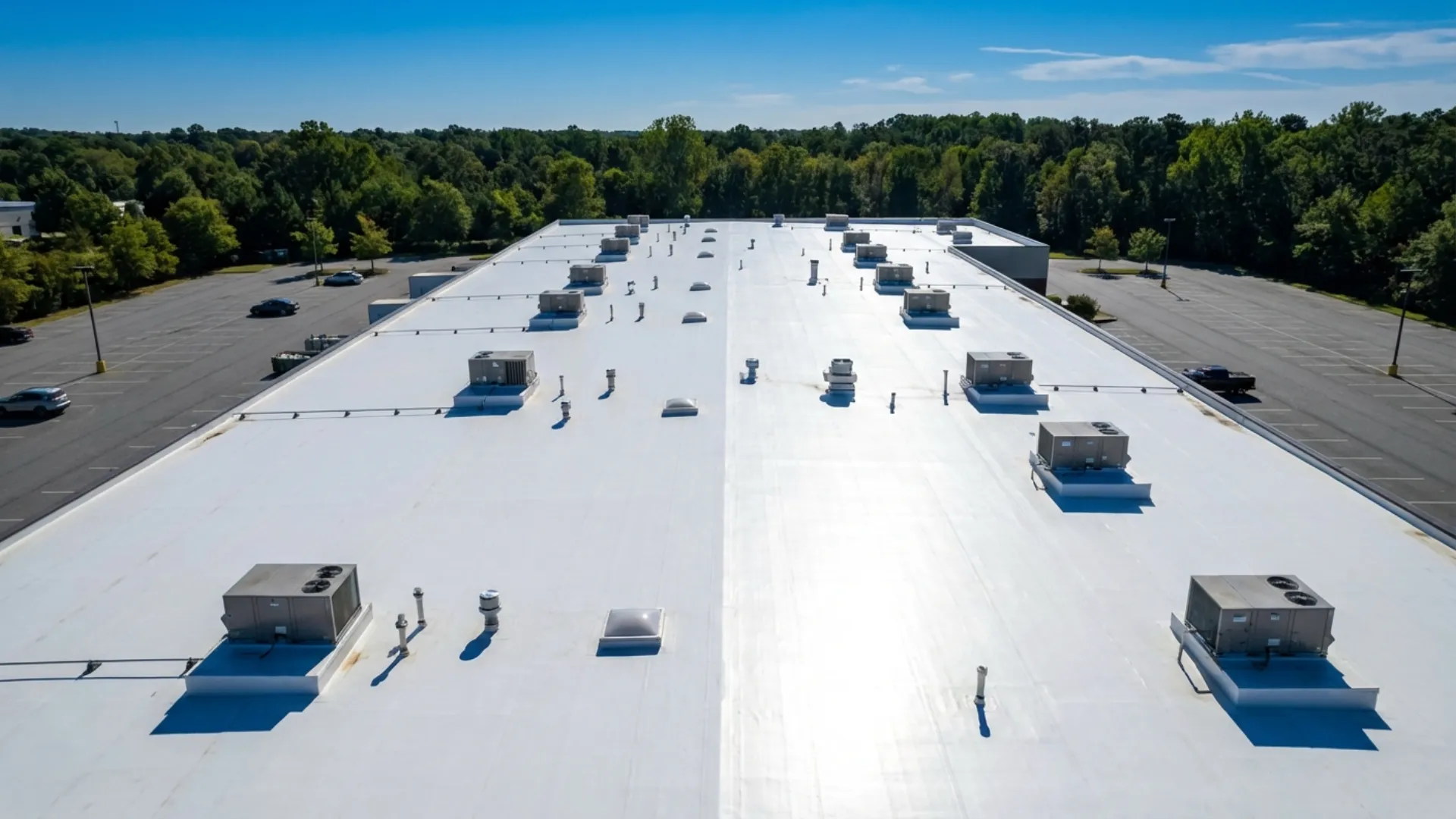
TPO — thermoplastic polyolefin — is the most widely installed commercial roofing membrane in North America, and for good reason. This single-ply membrane combines energy efficiency, durability, and cost-effectiveness in a way no other flat roofing material can match. The white reflective surface bounces up to 90% of solar energy away from your building, dramatically reducing cooling costs during Maryland's hot, humid summers.
Unlike older built-up roofing systems that require multiple layers and hot asphalt, TPO arrives in large rolls that are mechanically attached or fully adhered to insulation boards, then heat-welded at the seams. The result is a seamless, monolithic waterproof barrier across your entire roof. The heat-welded seams are actually stronger than the membrane itself — eliminating the most common failure point found in adhesive-based systems like EPDM.
At Crown Remodeling, we have installed TPO membrane systems on office buildings, retail centers, warehouses, and multi-tenant commercial properties throughout Maryland. Our crews are factory-trained and certified by leading TPO manufacturers including Carlisle, Firestone, and GAF, which allows us to offer manufacturer-backed NDL (No Dollar Limit) warranties that cover both materials and labor for up to 30 years.
TPO is available in 45-mil, 60-mil, and 80-mil thicknesses. For most Maryland commercial buildings, we recommend 60-mil as the standard — it provides excellent puncture resistance, UV stability, and long-term performance at a competitive price point. Buildings with heavy rooftop equipment or high foot traffic benefit from upgrading to 80-mil for additional durability and the longest available warranty terms.
ENERGY STAR Rated
White TPO reflects up to 90% of solar energy, reducing cooling costs by 10–30% for Maryland commercial buildings.
Heat-Welded Seams
Seams fused at 900°F create a bond stronger than the membrane itself. No adhesive failures.
20–30 Year Lifespan
With proper installation and maintenance, TPO delivers decades of reliable, leak-free performance.
NDL Warranties Available
Manufacturer No Dollar Limit warranties covering both labor and materials for up to 30 years.
TPO Roofing Pricing by Building Size
Pricing depends on membrane thickness, insulation requirements, building accessibility, and roof complexity. All prices include materials, labor, and cleanup.
Under 5,000 Sq Ft
Retail spaces, small offices, strip mall units, and professional buildings.
- 60-mil TPO membrane standard
- Full tear-off and insulation
- All flashing and penetration details
- 15–20 year manufacturer warranty
- Project total: $25,000–$40,000
5,000 – 15,000 Sq Ft
Office complexes, retail centers, multi-tenant buildings, and medical offices.
- 60-mil or 80-mil TPO membrane
- Tapered insulation for drainage
- New drains or scuppers as needed
- 20–25 year NDL warranty available
- Project total: $35,000–$105,000
15,000+ Sq Ft
Warehouses, distribution centers, industrial buildings, and large retail.
- 80-mil TPO recommended
- Phased installation available
- Complete drainage system design
- 25–30 year NDL warranty available
- Project total: $67,500–$195,000+
Why Building Owners Choose TPO
TPO has become the dominant commercial roofing membrane for compelling reasons that impact your bottom line, building performance, and long-term maintenance costs.
Energy Efficiency
White reflective surface reduces cooling costs by 10–30%. ENERGY STAR rated. Maryland businesses may qualify for BGE utility rebates for installing cool roof systems.
Superior Seam Strength
Hot-air welded seams create a monolithic waterproof barrier. Seam strength exceeds the membrane itself, eliminating the most common flat roof failure point.
Cost-Effective
At $5–$8 per square foot, TPO delivers premium performance at a moderate price. Lower lifecycle costs than PVC with comparable energy savings and durability.
Weather Resistance
TPO handles Maryland's freeze-thaw cycles, UV exposure, high winds, and heavy rainfall. Flexible in cold weather and heat-stable in summer without softening.
Low Maintenance
TPO requires minimal upkeep compared to multi-layer systems. Biannual inspections and drain cleaning are typically all that is needed to maintain peak performance.
Recyclable & Eco-Friendly
TPO is 100% recyclable at end of life. No plasticizers that leach into the environment. Contributes to LEED credits for green building certification.
When to Choose TPO Roofing
TPO is the ideal choice for the majority of commercial flat roof applications, but every building has unique requirements. Here are the scenarios where TPO delivers the greatest return on investment.
- Office buildings and professional complexes seeking lower utility bills and a clean, modern appearance
- Retail centers and strip malls where energy efficiency directly impacts operating costs for tenants
- Warehouses and distribution centers with large, open roof areas that benefit from economies of scale
- Buildings pursuing LEED certification or other green building standards
- Property owners wanting the best balance of cost, performance, and warranty coverage
Consider alternatives if: Your building has significant chemical exhaust (choose PVC roofing instead), or you need the absolute lowest upfront cost on a simple flat roof (consider EPDM roofing).
TPO vs. Other Membranes
TPO Roofing Installation Process
Every TPO installation follows a systematic process designed for quality, efficiency, and minimal disruption to your business operations.
Roof Inspection & Assessment
We perform a thorough evaluation of your existing roof, deck condition, insulation, drainage, and penetrations. Core samples may be taken to check for moisture in existing insulation.
Proposal & System Design
Detailed proposal with membrane thickness recommendation, insulation R-value, drainage plan, and warranty options. We specify every component so there are no surprises.
Permits & Scheduling
We pull all required permits from your local jurisdiction and coordinate the installation schedule around your business operations and weather windows.
Tear-Off & Deck Prep
Existing membrane is removed and the roof deck is inspected and repaired as needed. Wet insulation is replaced. The deck is cleaned and prepped for the new system.
Insulation & Membrane Install
Polyiso insulation boards are installed to meet energy code R-values. TPO membrane rolls are positioned, mechanically fastened or adhered, and seams are hot-air welded.
Flashings & Detail Work
All penetrations (HVAC, vents, pipes), perimeter edges, and parapet walls are flashed with TPO accessories and heat-welded for a watertight seal at every transition point.
Inspection & Cleanup
Our quality control team inspects every seam, flashing, and detail. The roof is flood-tested or electronically scanned to verify waterproofing. Complete job site cleanup follows.
Warranty Registration
Manufacturer warranty is registered and documentation is provided. We schedule your first maintenance inspection and review ongoing care recommendations with your team.
TPO Roofing Across Maryland & Beyond
Licensed in 4 states. We serve businesses and property managers across these counties and more.
TPO Roofing FAQ
TPO roofing in Maryland typically costs $5 to $8 per square foot installed, depending on membrane thickness, building size, insulation requirements, and roof accessibility. A 10,000 sq ft commercial roof runs approximately $50,000 to $80,000 fully installed. Larger buildings benefit from economies of scale, with per-square-foot costs dropping as roof area increases. We provide free on-site assessments with detailed proposals so you know exactly what to expect.
TPO is a white thermoplastic membrane that reflects solar energy and reduces cooling costs, with heat-welded seams that create a monolithic waterproof barrier. EPDM is a black rubber membrane that absorbs heat but offers excellent cold-weather flexibility and a lower upfront cost ($4–$7/sq ft vs $5–$8/sq ft for TPO). TPO is the better choice for energy savings and long-term warranty coverage. EPDM is better for budget-conscious projects where energy efficiency is less critical.
A properly installed TPO roof lasts 20 to 30 years. Membrane thickness plays a significant role: 60-mil TPO typically lasts 20–25 years, while 80-mil TPO can reach 25–30 years. Regular maintenance — including biannual inspections, drain cleaning, and prompt repairs — helps maximize lifespan. Manufacturer warranties range from 15 to 30 years depending on the system and thickness selected.
Both are excellent thermoplastic membranes with heat-welded seams. TPO costs less ($5–$8/sq ft vs $6–$10/sq ft for PVC) and offers comparable energy efficiency and lifespan. PVC is superior for chemical resistance, making it the better choice for restaurants with grease-laden exhaust, auto repair shops, and industrial facilities with chemical exposure. For standard office, retail, and warehouse buildings, TPO offers the best overall value.
TPO membranes are available in 45-mil, 60-mil, and 80-mil thicknesses. We recommend 60-mil as the standard for most commercial buildings — it offers a strong balance of durability, UV resistance, and cost. 80-mil is recommended for high-traffic roofs, buildings with heavy rooftop equipment, or when maximum warranty coverage is desired. 45-mil is a budget option suitable for small buildings with limited roof traffic, though the reduced lifespan typically makes 60-mil the better long-term investment.
Yes, white TPO membranes are ENERGY STAR rated and qualify as cool roofs. TPO reflects up to 90% of solar energy, significantly reducing cooling loads and lowering utility bills by 10–30% depending on building size and HVAC efficiency. Maryland businesses may also qualify for utility rebates from BGE and other providers for installing energy-efficient roofing. The energy savings typically offset the cost premium for TPO over darker membranes within 3–5 years.
TPO seams are welded using a hot-air welding machine (like a Leister Varimat or similar robotic welder) that heats the membrane to approximately 900°F, fusing the overlapping sheets into a single monolithic layer. The process is automated for field seams, ensuring consistent temperature, speed, and pressure. Detail work around penetrations and edges is done with handheld hot-air guns. The welded seam is actually stronger than the membrane itself, which is why TPO and PVC outperform adhesive-based systems like EPDM at the seam.
TPO roofs require minimal maintenance compared to multi-layer systems. We recommend biannual inspections in spring and fall, clearing debris from drains and scuppers, checking seams and flashings for any separation, and ensuring no ponding water persists for more than 48 hours after rain. Prompt attention to minor issues prevents costly repairs down the road. A maintenance plan typically costs $500 to $1,500 per year depending on roof size, and maintaining one is usually required to keep manufacturer warranties valid.
In many cases, yes. TPO can be installed over an existing single-ply membrane or built-up roof if the existing insulation is dry and the deck is structurally sound. This “recover” approach saves on tear-off and disposal costs, often reducing the project cost by 15–25%. However, building codes limit the number of roofing layers (typically two), and the existing roof must be thoroughly inspected with core cuts to verify dry insulation. We evaluate every roof individually to determine if a recover is appropriate or if a full tear-off is needed.
TPO roofing systems come with two warranties: the manufacturer warranty covering materials (15–30 years depending on the system and thickness) and our workmanship warranty covering installation quality. We are certified to install systems with manufacturer NDL (No Dollar Limit) warranties that cover both labor and materials — meaning if a covered issue arises, the manufacturer pays for everything with no cap. Maintaining a regular maintenance plan is typically required to keep manufacturer warranties valid.
Ready for a TPO Roof Assessment?
Get a free on-site evaluation and detailed proposal for your commercial building. No pressure, no obligation — just expert advice from Maryland's trusted TPO roofing contractor.